Saturday, June 2, 2012

The Meta Post: Covey and Me

     My favorite blog post this quarter was my post titled "Frederick Douglass and Covey, One More Time." The Covey fight scene captured our attention as a class for its questionable plot details and exaggerations. The reason this fight was the centerpiece of a post in April, when we read Frederick Douglass in January, is because I came across a parallel in Karl Marlantes' What It's Like to Go to War during my junior theme research. 
Illustration of a bar fight.
Via http://www.tentimesone.com 
An illustration of Douglass
 fighting Covey. Via
http://www.jackandjillpolitics.com
     Unlike my other posts, this post was one that I had been thinking about writing for a couple of weeks before I posted it. I knew that the connection between Covey and the line in Marlantes' book was too good to ignore, but frankly I didn't feel like delving into quote analysis and didn't know how to approach this post. 
     Once I did sit down to do the post, I think I did a very good job of identifying a very American theme: our love of fighting. Just like in our class discussion months earlier, I contrasted the length and purpose of actual fights and those of constructed, fake, for entertainment purpose fights. 
     In comparison to the beginning of the year, I pulled out a quote and actually analyzed it, while also providing other forms of evidence from our class discussion. 
     My only regret with this post is how I ended it. In most of my posts, I try to end with a thoughtful, thought-provoking question that allows the reader to comment whether it be in agreement of disagreement. In this post, I neglected to do that. I ended with more of a wrap-up type finish. That could be one of the reasons no one commented on it. While I didn't completely close off the post for discussion, I could have ended it with a question like, "How would Douglass' story have changed if the length of his fight with Covey had been shorter?" or "What is so American about fighting and fights?" 
     Regardless, this post showed the parallels between two texts, written 155 years apart from each other. Finding that line in Marlantes' book immediately brought me back to our class discussions and gave me a new appreciation for the Covey chapter in Douglass' narrative. Finding this same theme discussed in another book, validated our days of class discussion. 

Tuesday, May 22, 2012

My New Disappointments in Reality TV

       I, like many teenage girls, watch The Bachelorette. I have watched intermittently throughout the last couple years, but is the first season that I will watch fully. In the premiere, something struck me: the creation of the villain. This season's villain is named Kalon McMahon and he arrived to the show in a helicopter, while everyone else came in limos. Even more, he arrives last, adding to the drama and causing all the men to hate him. He is then portrayed as a complete jerk, and this is all in the first episode. 


       Now I realize he could very possibly be a jerk, but I also know that while it's supposed to "reality" television, the producers created McMahon's character. The way that the producers cut scenes influences how the viewers see different characters. As we talked about in first semester, everything is a construction. Most people know that reality shows are not really reality but these producers and many other producers have a specific storyline to fulfill and it has to be full of drama. McMahon even said this in the premiere: “I’m not here to make friends." If that isn't fed to him by the producers then I would be very surprised.


     While I am a huge fan of the show, I know to approach it with some skepticism. It is purely for entertainment and really isn't reflective of anybody's reality. I wonder if the show could survive without infusing story lines and drama. To compare it to an earlier show, Lauren Conrad of The Hills said that during that when they were filming they were always checking there phones from producers to see if they needed to discuss a certain topic or do something. (For the full interview click here). 
      
     These shows are my guilty pleasure. I know it isn't art or anything like that but it is entertaining. But finding out that so many of the aspects of the show are staged is a little disappointing. Do you think the above things take away from the value (which is already pretty low I will admit) of the show? Why is this television called "reality tv?" 

Monday, May 21, 2012

The Unchanging Nature of Beliefs

via theblaze.com
     Today in class we discussed and read an excerpt from White Noise and discussed the idea of "belief." Immediately I thought of my favorite John Mayer song titled, you guessed it, "Belief." The song opens with the following verse:


"Is there anyone who?
Ever remembers changing their mind from
The paint on a sign?
Is there anyone who really recalls
Ever breaking rank at all 
For something someone yelled real loud one time" 

Mayer is discussing the idea of one's beliefs and how protest or propaganda can or cannot change them and he makes a great point. He believes that it is rare for protests or signs to actually change someone's beliefs. I would have to agree with him.  Specifically, with the 2012 elections growing closer, I wonder what real impact political debates have on people. These are times for politicians to voice and support their opinions to the public against their competition but how often to these debates actually change the beliefs of viewers? 

Even more, with the NATO summit in Chicago, protestors were all the news this weekend. But it seemed that more attention went to controlling the protesters and maintaining safety than to the topic of their protests. I find it difficult to believe many people's opinions were changed by the NATO protesters. In what ways can one's beliefs change? How much impact do protests or signs really have on one's beliefs?
for full lyrics click here

Sunday, May 6, 2012

Gatsby's Parties and Human Behavior


"People disappeared, reappeared, made plans to go somewhere, and then lost each other, searched for each other, found each other a few feet away" (Fitzgerald 37). 

While Fitzgerald was referring to a specific party at Gatsby's house, I found this statement parallel to the relationships and interactions between acquaintances throughout a lifetime. Fitzgerald recognizes a very common behavior: people grow apart, see each other again, promise to meet up again, lose each other again, and then see each other again. I know this is true for me. I will see someone I used to be close with and immediately wonder why I'm not closer with them, make plans with them, but of course those plans will fall through. In fact, it seems that Fitzgerald is almost making fun of how superficial people can be and how people lose touch so quickly with people they claim they are close with. 

Pages later, Fitzgerald does almost the same thing, referencing a seen at Gatby's party, saying, "The groups change more swiftly, swell with new arrivals, dissolve and form in the same breath..." (Fitzgerald 41). Instead of talking about how two people interact, now he is referring to how groups change over time.  

Do you think Fitzgerald is making a valid point about human behavior? Why does he use Gatsby's parties to make this point? 

Thursday, April 19, 2012

Scott's Wrist, A Turning Point

As I blogged about earlier, I have found a lot of statistics regarding veteran suicides. But nothing I had found thus far was as stunning and moving as the following photo and story behind it. (Thanks to Mr. Bolos for emailing this along!)
A picture of Scott's wrist days after he attempted to commit suicide
with a kitchen knife during an argument with his girlfriend. 
The photographs are of Brian Scott Ostrom, a 27 year old who had served four years in the Marine Corps and came home with severe PTSD. I had had my doubts about how substantial my thesis and how big of a phenomenon veteran suicides actually are. After all, most veterans don't commit suicide.

The wall that Scott punched through in anger.
A distressed Scott, argues with
his girlfriend of the phone
Seeing these photographs substantiated my claims for me. In my head, I was thinking, "See, this is happening. I'm not making something out of nothing." These photographs freed me of my doubts. I couldn't get these images or Scott's story out of my head. No longer was my topic of military suicides only a statistic to me. It was Scott: someone who has attempted suicide, attempted to get treatment, and attempted to re-intregate back into society. I'll conclude with this: I'm sorry that this picture is graphic and morbid. For me, this photograph (and the whole set) was the source that made me care about my topic. 

The photos were taken by Craig F. Walker, who works for the Denver Post.
Click here to see all 18 photos.


Tuesday, April 17, 2012

Frederick Douglass and Covey, One More Time

It was in my reading of Karl Marlantes' What it is Like to Go to War,  a title I have mentioned many times on my blog over the last couple of months, that I found myself thinking of Frederick Douglass. For me this was odd, because at the time, The Life and Narrative of Frederick Douglass was a book I found particularly bland. It wasn't until our extensive study of the Covey fight that I began to foster more of an interest in LNFD.

At this point, deep into my junior theme research and surely stressed out, I had all but forgotten about Douglass. But then I read the following line and I was back in first semester, studying slavery.


"Fighting on television lasts long enough to entertain people.
 Fighting in bars doesn't have the same purpose" (Marlantes 14). 

This immediately reminded me of our discussion about the length of the fight between Douglass and Covey. Douglass had, in more editions that one, described the fight saying that "two hours has elapsed" before Covey gave up. As a class, we all questioned whether or not this was supposed to be taken as an exaggeration or if Douglass and Covey had actually fought for two hours. Graham mentioned that a six minute wrestling match left him exhausted, so he doubted that this was realistic. We concluded that while Douglass might not have been trying to lie, he was most likely exaggerating to make a point, to emphasize the fight.

Marlantes brings up a similar thing here. Fights, on television go on and on because that's how people are entertained. But a real fight, like a bar-fight as Marlantes states, those fights are quick and painful. The audience wants a drawn out drama filled fight. And Douglass probably knew that. While his fight with Covey was probably longer than a bar-fight, he knew that a longer fight would be better for his audience. Douglass and Marlantes, 155 years apart, bring up the same phenomenon. We love fights. We love the drawn out drama. No one cares about a little punch, it has to be more than that. 

Wednesday, April 11, 2012

My Search for Statistics, Not Anecdotes

Sgt. Jacob Blaylock
         My research on the topic of veteran suicides during the Iraq and Afghanistan wars has provided me with a lot of statistics. Everyone loves statistics but at some point, there is only so much one can do with them. Sure, this stat- "Of the more than 30,000 suicides in this country each year, fully 20 percent of them are acts by veterans"-is staggering. But what exactly does that mean? How can that be put in context? 


         It wasn't until I found a six-page article chronicling the life and suicide of Sgt. Jacob Blaylock, that I realized how important personal anecdotes are in my research. His story, from when he began his service, to the close deaths of two of his comrades six days before he was scheduled to come home, to the psychological problems he faces upon returning home, up until his suicide in 2007, provide me more information and context than many statistics can. I realized that I need to include more evidence than that of the logos type. Logos, according to about.com, is "persuasion by demonstration of logical proof." But having diverse sources also means having diverse evidence: Ethos and Pathos. While ethos and pathos mean nothing without logos as the backbone, these types of evidence are just as important. 

For some reason, though, we are attracted to statistics. I think I can speak for a lot of fellow students in saying that we crave statistics for our paper. Maybe it's because citing statistics is easier than anecdotes. Maybe it's because we think those statistics speak for themselves. But, as we have learned this year, no evidence speaks for itself. No statistic can speak for itself without context. 

Why do you think we crave statistics so much? In what ways are personal anecdotes more useful than statistics? 

Monday, April 9, 2012

White Noise, Media, and Our Soldiers

As you have seen in so many of my posts this year, and particularly in the last two posts, I have a huge interest (and junior research paper) in the topic of the military, but specifically in the battles that troops fight at home upon returning from war. As I was glancing through White Noise, this particular passage stuck out at me (DeLillo 92).

"Where's the media?" she said. 
"There is no media in Iron City." 
"They went through all that for nothing?"  

This passage is referring back to the incident that is described to Jack about the plane that almost went down but didn't. Apparently, no media was there to cover the story, therefore making it less important and less of a miracle. 

via this link
Now, as the wars in Afghanistan and Iraq carried on for eleven (and counting) and eight years respectively, the media coverage of the wars has also lessened. It's no longer always on the front page. It's as if, like in Iron City, there is no media there. But what does this mean? It means that the troubles and conflicts our troops go through go untold in America. It means that soldiers fight for their country and get little support upon returning. It means that the pride of serving your country barely leaves your platoon and family. It means that since the media doesn't cover the daily personal battles going on in Afghanistan and Iraq, those things almost cease to exist to the general American population. It's almost as if that same question from White Noise needs to be asked: 
"They went through all that for nothing?"  


These aren't our grandparents' wars

          I found this advertisement in my research on suicides among Iraq and Afghanistan veterans. For some reason, in stuck in my mind. To me, this idea of the disconnect between civilians and the military is one of the reasons why the suicide rates for combat veterans rose as the Iraq and Afghanistan wars continued on. I know the print is small- it states, 

"99% of American have seen combat on TV. 1% of Americans have seen combat in Iraq or Afghanistan." 

          Most present day Americans have less of a connection with the military than Americans did during WWI, II, and Vietnam. In a Tampa Bay Times article I found via LexisNexis, the author cites a Pew poll that found that during the 1980s, at least 40% of 18-year-olds had a military parent. In the 1990s, that number had dropped to 18%. Now, it states, "almost 70% of military-age American no longer have any direct ties to the military." This all links back to the isolation, separation, and uselessness that some veterans feel once they return home from combat. People don't understand their story. Not every man their age has served or has a brother who has served. Their is no longer a shared experience of war that was their during our previous wars.  But how can this be fixed? A draft? Shorter wars?


Wednesday, March 14, 2012

Is a Yellow Ribbon enough?

Do we?
I have blogged twice this year (The Draft Wars and Just One Day Isn't Enough) about the military and how we, as civilians in America, treat veterans returning home from war. As junior theme approaches, I know I want to focus on the military, but instead of focusing on the wars and battles in Iraq and Afghanistan, I want to focus on the wars and battles that happen in the United States to veterans returning home and their families.


My dad, an avid reader of military books introduced me to a book titled, What it's like to go to War by Karl Marlantes, a Vietnam veteran. I began researching and found an interview he did about this book for the beloved NPR. In it, he says,


'There are yellow ribbons, beer commercials showing people clapping at airports, and banners on freeway overpasses. There is the well-intended 'thank you for your service,' and a hasty handshake." 


I think he perfectly characterizes how society reacts to the return of troops. Of course we care, this isn't Vietnam, where as Marlantes writes in his book that he was spit on by a young women when he was in uniform. These days, we say we care. We respect those who serve, but is caring and respecting troops and veterans enough? Marlantes doesn't think so, and I don't either. Hopefully, I will be able to explore this topic further over the next month.


Why is there a disconnect between military and non-military in the US? 
Why don't we try to better our treatment of returning troops and veterans so that their transition is easier?  

Sunday, March 11, 2012

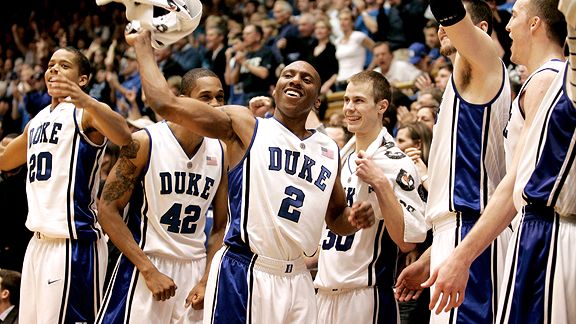
Why We Love to Hate Duke

It's Selection Sunday, the start of the best time of the year for college sports fanatics. For these fanatics (me included) the month of March is filled with excitement, anxiety, anger, happiness, and many near misses in class when the teacher almost catches you streaming live game footage to you iPhone. But most of all, it's a time for people to root against Duke, unless of course, you are a Duke fan.

Let me give you some personal history regarding my relationship with Duke.

Via thevictoryformation.com

  • No one in my family has gone there
  • Until I was about 13, I picked Duke to win every year. Once I got my bracket, I immediately penciled (this is before the online bracket) in "DUKE" throughout the bracket.
  • When I reached the above age, I realized that my brothers and my dad hated Duke, so I began to hate Duke. 
  • Now, I don't know whether I love 'em or hate 'em, I just know a lot of people hate Duke (*cough *cough, Doc O'C), and I want to figure out why.
So why does anybody that doesn't go to Duke, doesn't have a family connection to Duke, doesn't live in Durham, absolutely distain Duke and Duke Basketball? 

Well, it's definitely a combination of things, but I'll delve into the fact that unless you are a fan of the team, when a team has great success in a certain era, you are likely to despise that team. Whether they keep beating your team, whether they keep appearing on your tv, or whether you are just plain jealous, you will start to feel negatively about this team. 

In an article from last March, right before the tournament started, CNN contributor Terrance Moore, covered this same topic. In his article, he quoted Jay Bilas, a sports analyst and Duke grad, saying, "For years, people hated Notre Dame football. For years, so this hatred is not unique to Duke. People don't hate (mediocre) teams."

Via bracketmadness.wordpress.com
When a team keeps winning, it gets annoying unless you are a fan of that team. The thing is, Duke has only won the Tournament four times ('91, '92, '01, '10). Granted, in the Coach K era, they have won a NCAA best 79 tournament games and had 11 Final Four appearances. 

So while I agree with Bilas, that this hatred may not be solely something Duke and Duke fans have to deal with (Yankees, Lakers, Cowboys maybe), there is another reason we love to hate Duke. 

It has to do with how elite Duke is not only athletically, but also academically. How often can a school maintain athletic excellence while still being one of the most selective schools in the country? Duke is better than you, and Duke wants you to know that. I know it isn't as simple as that. Jalen Rose and the Fab Five can tell you some other reasons for hating Duke. As a matter of fact, I bet everyone could give you a reason for why Duke is the enemy. 

Now let me ask, why do YOU hate Duke? 


Tuesday, March 6, 2012

What about you, Rush?

At this point, it's Rush Limbaugh vs. Women. Maybe not all women, especially those fundamentally against contraception, but let's say a vast majority of women are not too happy with Mr. Rush Limbaugh. Why, might you ask, am I, and so many other women angry with him? 


Limbaugh on the left, and Fluke on the right. 
Well, as you probably know, Limbaugh called Sandra Fluke a "SLUT" and a "PROSTITUTE" for testifying in front of a panel, pushing for contraceptives to be included in health care coverage. This is the same Rush Limbaugh that has BEEN MARRIED 4 TIMES! Really Rush? Really? Are all women that simply want to control when they get pregnant "sluts" and "prostitutes?" How come a man can't be called either of those two words? How come you, a man who has by my guesses engaged in premarital sex and/or extramarital sex, call a well-educated women these things? 


And it gets worse, believe it or not. His apology, after backing his statements again days before is the following:
"In this instance, I chose the wrong words in my analogy of the situation. I did not mean a personal attack on Ms. Fluke."

In what way is singling out a woman and calling her a "slut" and a "prostitute," not a "personal attack." I can't seem to think of another instance that is more of a "personal attack."  

What do you think of this story? In what ways does this make you question the use of the word "slut?"


Tuesday, February 28, 2012

TV Tokenism


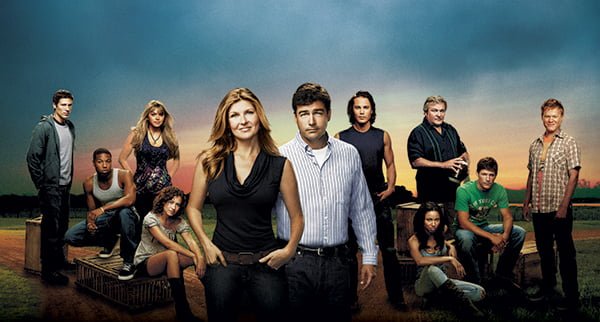
NBC's (and DirecTV's) FRIDAY NIGHT LIGHTS

FIRST SEASON


Smash is only black main character in the first set of characters. He is developed emotionally. 
The Taylors, the main family, which everything revolves around, is white.


 FIFTH SEASON
Season 5, Episode 3
1:05-End


Vince is the only black male character in the second set of characters. He is poor, has had trouble with the law, a very good athlete, has father issues, hmm... But, he is very developed emotionally and is NOT the "token black guy."
Now, we have a black female character as well. At first she dates Landry, the boy on the right, but then soon starts dating Vince again.


Sunday, February 26, 2012

It's as Simple as Black and White

Friends is one of the most famous and timeless shows of the last 20 years. It captivated 20-somethings, 30-somethings, and even teenagers. It captivated me a couple years ago and I'm sure many of you as well. I've seen every episode, at least two or three times, and that's not even that much compared to even bigger fans. I've bought books about the show. I've searched the corners of the internet for information/facts/gossip regarding a show that ended eight years ago. 

But it wasn't until I was sitting in class on Friday, that I realized that there are almost no black people in Friends. I'm not just saying that none of the six friends are black. That's obvious and I knew that. But look around the coffee shop and look at who they date. It's white. Very white with a few exceptions: Ross dates Julie, as Asian-American, Ross and Joey both date Kristen, played by Gabrielle Union, for one episode, and Joey and Ross both briefly date Charlie, a black women. I'm sure I'm forgetting a couple of characters, but you get my point. Friends is white. But why? The show is set in New York City. Are you telling me that there are no twenty-something, hip, urban black people, in NYC from 1994-2004? I don't think that's why.

But what would it be like if one of the friends was black? Would they make race part of the show? I don't think NBC wanted that burden. I don't think they wanted to have to explain how one black man or women ended up friends with five white people from Queens or Long Island. It is because black and white groups of friends don't exist? Is it because the creators, David Crane and Martha Kauffman, didn't think these groups existed? Is it because having a mixed group of black and white people wouldn't appeal to a black or white audience? 

Monday, February 20, 2012

My Trip to Vegas

I just arrived home from a visit to Las Vegas, Nevada. I went there for a soccer tournement but I also had the pleasure of seeing the Bellagio Casino. I had never been inside a casino before, much less played roulette or the slots. I was with my parents, a friend, and her dad after seeing Cirque du Soleil and they decided to let me see what attracts millions of people to Vegas: gambling.


The Bellagio Casino, one of the nicest casinos in Vegas.

The friend's dad, we will call him Mr. Jones, went to an ATM machine and withdrew a crisp $100 bill. Let me add that he paid a $5 ATM charge for that withdrawal. Next, we walked over to the Roulette tables, where Mr. Smith, the somewhat experienced gambler chose a table. He watched the table for a couple minutes and then sat down and exchanged his $100 bill for 20, $5 chips. Then he started betting. I watched, hoping he would "hit it big." He didn't. I think it took 5 minutes for his $100 to become property of the Bellagio Casino, leaving him with nothing to show for it except a desire to gamble more.

Don't get me wrong, he had fun, my parents had fun, and my friend and I had fun. It was very odd though. He had just lost $100 in about 5 minutes but he hadn't lost much in comparison to the majority of the people in the casino. The value of money at casinos is so different from any other place. At what other place can you spend $100 and have nothing to show for it? What does this say about us as Americans- or rather those that gamble, that they just give their money to these casinos with a small chance of "hitting it big?"

Wednesday, February 8, 2012

Derrick Rose: America's Anti-LeBron

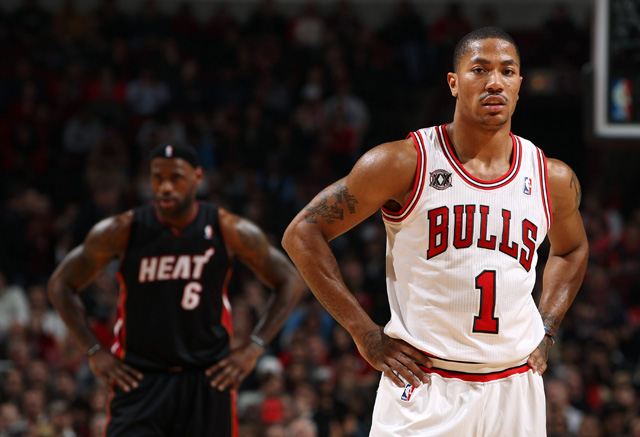
        If you know me well, then you know I love Derrick Rose. I love the Bulls, I love NBA basketball, but I love Derrick Rose the most. I'm not alone--Chicago loves Derrick Rose. And many NBA fans favor Rose over other superstars like Kobe Bryant, LeBron James, and Dwayne Wade. 
       
        While I believe Rose is as talented as those players, some people don't. In this post, I am just going to focus on Rose vs. James. On the court, he doesn't argue calls like James, but at the same time, he isn't as polarizing of a player as James. To me, and many NBA fans, part of Rose's allure is who he is off the court. He is so much of what we as Americans want in our athletes: Strong, talented, captivating, while still maintaining a humble and quiet profile off the court. 


The picture that briefly took over the media,
but never really threatened Derrick Rose's image. 
        As Rose fans, we have constructed this persona that is Derrick Rose. We see him as modest and shy, and dispute anybody who says he's selfish. After all, he grew up in Englewood, rooting for the Chicago Bulls. He's our hometown hero. And at this point, no scandal has overthrown him as the new king of Chicago. Sure, Derrick has made the news with minor scandals, first the picture of him flashing a gang sign, and then the news of him not taking his SAT to get into Memphis. As fans, we have pardoned him from those bad decisions. 


        We all know James' "scandal." He ripped the hearts out of the Cleveland faithful when he televised his decision to join Dwayne Wade and Chris Bosh in Miami. He comes across as cocky and arrogant. He said the following comments after losing to the Mavericks in last years NBA finals: 


“All the people that were rooting for me to fail… at the end of the day, tomorrow they have to wake up and have the same life that (they had) before they woke up today. They got the same personal problems they had today." 


       You really aren't helping yourself, LeBron. We get it, you make A LOT of money, but you don't have to remind people that regardless of losing, your life is still better then theirs. Derrick would never say anything like that (and if he did, it would somehow be okay). Are we (yeah, you hate James too) right in criticizing James for everything he does? Why do we hold James to a higher standard than Rose and any other player in the league?


Interested in reading more about the most hated NBA players? Click here for a list brought to you by Forbes.

Thursday, February 2, 2012

College Admissions Incorporated

I don't want to brag or anything, but I got about six college letters from colleges today. Hofstra, Carthage, Simpson, Minnesota, and SMU- apparently they all want me. 


I received this email from Babson College, who
is apparently on a first name basis with me. 
Or that's what I'd like to think. But I realized a long time ago, when I got emails from Brown and University of Virginia, schools that they don't really want me, as I'm not academically qualified. Rather they want my application. They are supposedly "impressed" with me, as Babson College is, shown to the right.

The college admissions process is a business in itself. Colleges and universities want their school to look better than other schools. They want their  U.S. News and World Report ranking to be higher. They want more applicants, regardless of whether of not they are qualified. They want to seem more prestigious.

Just take Claremont McKenna's recent scandal in which the school submitted false SAT scores to raise its ranking in The U.S. News and World Reports College Rankings. While the difference in the actual scores seems minimal, sometimes only 10 points, it still makes a difference in the rankings according to a New York Times article.  In the article, Robert Franek, the senior vice president of publishing for The Princeton Review, said, "10 points, 30 points to a student that isn’t getting that score on the SAT could be an important distinction." While this case may be specific to Claremont McKenna, its clear that colleges will do anything to look better. 

What do those college emails and letters mean to you? How do you think the business of college admissions and rankings affects high school students?

Thursday, January 12, 2012

The Meta-Post

           I remember being really proud of my first post. It was about September Eleventh, and I had taken quite some time to construct it. It was first blog post, and I thought I was a natural. This is really for me, this blogging stuff, I thought. But now, I see that blog post, and some others to be honest, as stains on my internet identity. I know I shouldn't be, but I'm almost embarrassed by that post.
           First off, I don't think I wrote about a particularly interesting aspect of 9/11. I told a story of an event that took place ten years ago and reflected on it. I didn't pose a question. I didn't really leave my post open to opinions aside from the "that's a nice story" or "you are right, those people were so heroic." But the point of our blog isn't to have people agree with you. It isn't to have people pat you on the back. The point of our blog is to discuss something, connect it to a text, connect it to an American theme, and pose questions that get people thinking.
           I'd like to say that I fixed this problem right away, but I didn't. For my next posts, I neglected to pose questions, to ask what the reader thought. I ended my Into the Wild post with this sentence: "The movie should compliment the book, not fictionalize it." I ended my post, a post in which I didn't actually quote Krakauer, by restating my opinion. By doing this I closed off my post, making readers and commenters the extra burden of responding to my whole post, not a centralized question. Talk about lacking empathy for the reader. I think I did a much better job of this as the semester progressed. In my most recent post, I ended it with this question: 


"Does the dramatization of this story take away from the power of the film? Should directors be able to claim it as 'based on a true story?' Is this intellectual honesty?"

              I asked a specific question that directly related to something we talked about in class. My only problem with these questions is that I asked three yes or no questions. While they definitely give the commenter the ability to go further than "yes" or "no," I could pose my questions in a better way, just like we talked about for our oral history paper.  
My Rick Perry "Strong" Post.
           As my blunders were brought to my attention by my peers and my teachers, I began to reevaluate my "blogging technique." I shortened my posts, because most people these days don't read anything all the way through. I began spending 5-10 minutes just thinking about layout- How should I space this? Does this picture work better here or here? How can I embed this link so it doesn't look awkward? Sure, the assignment was about writing, but it was just as much about the visual aspects. For this blog right now, I'm thinking about how I can make it visually appealing. 
           My favorite post is on Rick Perry's "Strong" commercial. Writing wise, I'm not sure this is my best work. But I feel like everything came together for this one. I embedded a short video, pulled out a quote, analyzed, argued, and then posed a question to the reader. I'm sure I could even make this post more concise, but this post shows how the aspects of blogging came together for me. A screen shot of the post is to the right.
           The burdens of blogging are unlike any other type of writing. There is no embedding videos or pictures to research papers. I don't have to worry that people won't have the attention span to read my whole paper. But on the internet, these things all come together. Here, the writer, has to have the most empathy for the reader, because that reader can just "X" it out, or click on another link.
          
to pose a question... Did I do a good job of keeping your attention?